Selection Decisions
We want to maximize hiring the good people. We want to minimize incorrect decisions (missing out on good candidates).
In personnel psychology, the goal is to maximize hits and minimize misses.
Hit Rate is the percentage of cases in which a test accurately predicts success or failure on those people selected and rejected.
True positive ("HIT"): applicant accepted and performed well True negative ("HIT"): applicant rejected and performed poorly False positive ("MISS"): applicant accepted and performed poorly False negative ("MISS"): applicant rejected and performed well
What are costs of being wrong?
- Bad false positives: jobs where people who are bad at their jobs can hurt people.
- Bad false negatives: competitor gets a big advantage
Combining Predictor Scores
Combining information:
- clinical decision making: use judgement to combine information and make decisions about relative value of different candidates.
- statistical decision making: combines information according to a mathematic formula.
Strategies for combining predictor score:
- multiple regression (compensatory)
- multiple cutoffs (non-compensatory)
- multiple hurdle
- combination
Compensatory model:
- combine all information in multipel regression equation
- assumes strengths in one skill area can compensate for weaknesses in other areas
- better to use when the stakes are not too high for bad hires
Non-compensatory model:
- separate cut scores; applicants must meet all cuts to be selected
- multiple hurdles; applicants must meet cut for predictor in each stage
If you use multiple predictors, they should contribute new information. I.e., predictors should be uncorrelated with each other to be confident to have confidence in selection decision. Predictors should be correlated with the criterion to be confidence to have the confidence in selection decision.
Regression analysis is a statistical technique used to predict "criterion" performance on the basis of a predictor score. This follows the compensatory model. E.g., where is the predicted performance and is the predictor score. Multiple regression analysis involves the combination of two or more predictors.
Common model for making decisions is the multiple hurdles approach. It narrows down the applicant pool by using multiple assessment tools. It maximizes the efficiency of resources by utilizing the most time and cost intensive resources on the best qualified individuals. This should be used when there are severe consequences for a bad hire.
Assessment order:
- common first hurdles: application, resume, occupational questionnaire, biodata
- These are cheap and easy to administer to a large number of people
- common second/third hurdles: cog ability test, personality test, situational judgment, work sample, structured interview, assessment centers.
- These take more time and cost
Personnel Selection
Predictor validity r is the extend to which a score on a scale or test predicts score on some criterion measure. I.e., predicts job performance.
- the linkage between predictors and criterion is the essence of validity.
- This linkage is accomplished through methods of statistical decisions.
We want to use a predictor with high validity.
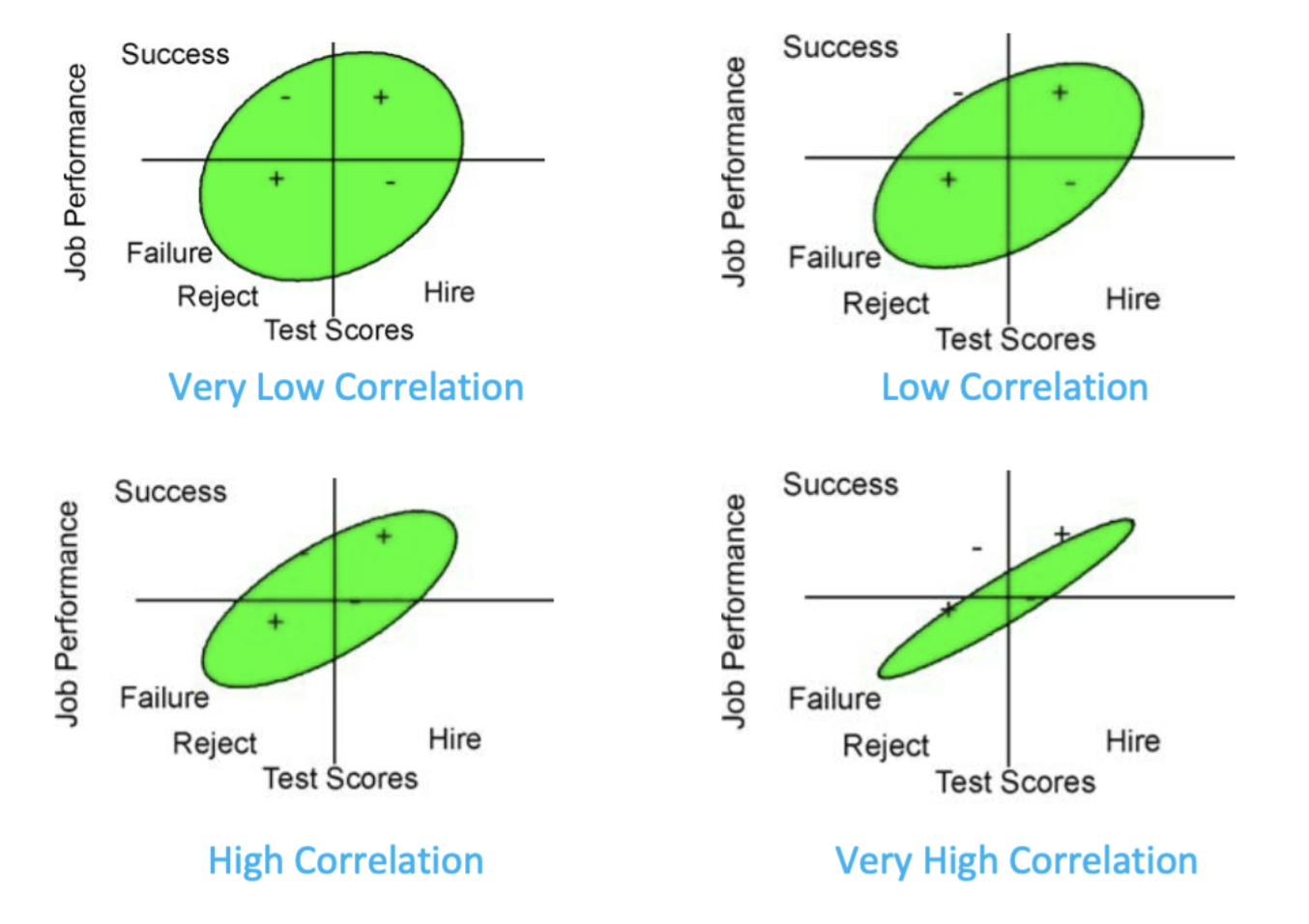
Selection ratio = the number of job openings divided by the number of applicants.
- do we want/need to hire a lot of people
- you can imagine it as a vertical line that acts as the predictor cutoff where applicants to the left are rejected and right are accepted.
- In general, other things being equal, the smaller the selection ratio, the more useful the test
- We don't want this to be too large because if we hire anyone who applies, we cannot be selective
Base rate of success (BR): The percentage of present employees who would be successful at their job if they were randomly hired or were hired based on an existing measure.
- If the base rate is already high, then the new methods for selecting employees will not improve upon it. The ideal situation for increasing value of a new predictor is when the base rate is 0.50.
The goal of personnel selection is to minimize false positives and negatives. SR,BR, and test's validity combine to select a strategy to increase the proportion of "correct" outcomes.
Approaches for making selection decisions:
- top down
- cutoff scores (empirical vs judgemental methods)
- banding: selection decisions will always have error, banding is an alternative to low cut-off scores, scores might fall within 95% confidence interval of the "true" score, scores that fall within 95% CI are considered as the same value. This tries to meet dual objectives (able candidates vs adverse impact). Is controversial.
Linked from Industrial and Organizational Psychology