Leadership, Power and Influence
Leadership Theories
Leadership is the influencing process of leaders and followers to achieve organizational objectives through change. Its key elements are:
- the ability to influence others
- goal oriented
- visionary
- sanctioned by followers
The roles:
- leader's job: establish an organizational mission -> formulate strategy for implementing mission
- manager's job: -> implement the organizational strategy
Many theoretical apporaches
The Trait Approach
Are leaders born? Are there a set of traits that all successful leaders have?
Research shows that characteristics may be associated with leader success but does not guarantee success. Traits will distinguish effective leaders from ineffective one.
These traits are: clear vision/strategy, intelligent, adaptive, develops relationships, energy level, self-esteem, self-confidence, integrity/honesty/morality, creativity.
Implicit Leadership Theory
Perceptions of leaders
Attribution theory proposes that leadership is merely an attribution that people make about other individuals
Cognitive categorization proposes that we develop beliefs about whether an individuals is a leader or follower, and then we draw inferences about their expected behaviors (even if it doesn't occur)
The Behavioral Approach
Are leaders made?
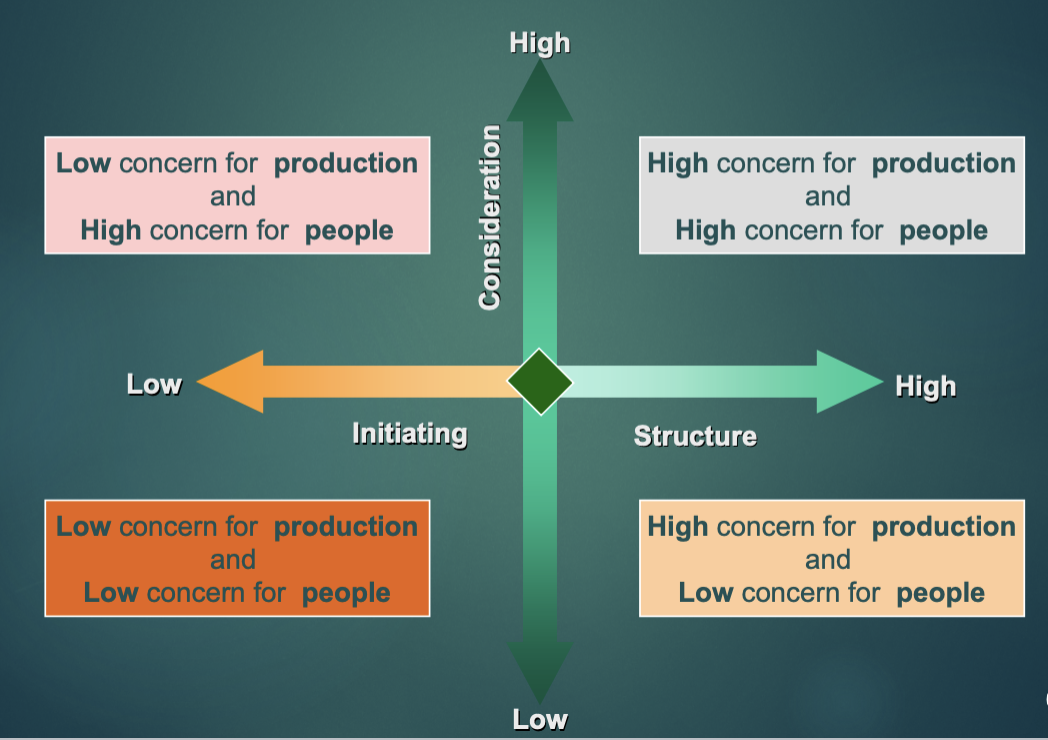
Two independent behavioral dimensions:
- initiating structure (how the work gets done): predicts leadership effectiveness
- consideration (how leader interacts with workers) predicts individual satisfaction with their leader
Effective leader behavior:
- monitoring employee's work and finding a solution
- clarifying a problem by delegating to able employees.
Contingency or Situation Approach
Considers the situation in which leadership occurs:
- Fiedler's contingency model: a leader's effectiveness depends on his/her orientation and situation favorability
Situations do matter, and yet they change: so leader adaptability is crucial
Leadership styles will depend on situation and external forces. Some of the forces are
- amount of time, are the relationships based on respect or trust, who has the information, how well are employees trained, stress levels, type of tasks, are there laws.
Leader-Member Exchange Theory
Leaders differentiate their followers in terms of:
- perceived competence and skill, extent they can be trusted, motivation for more responsibility, in-group vs out-group
Employees compare LMX relationships with others Updated version of LMX: leader motivated excellence, exchange relationships in the form of alliances are formed that are mutually beneficial.
in-group: more information, influence, confidence and concern from leader, more dependable, highly involved, and communicative than out-group
out-group: less compatible with the leader, usually just come to work, do their job and go home.
Transactional vs transformal (i.e., full range)E:
- transformational: attributed charisma (seen as powerful and confident, inspiring devotion), idealized influence (trusted role models with "extraordinary" capabilities), inspirational motivation (provide meaning and challenge to work), intellectual stimulation (question old ways to stimulate innovation), individualized consideration (coach each as individual)
- transactional leadership: contingent reward, active management by exception, passive management by exception
- non-leadership: laissez-faire.
Convergence among approaches, three consistent themes in leadership research:
- importance of influencing and motivating
- importance of maintaining effective relationship
- importance of making decision.
Power and Influence
Dark side of leadership
Some leaders are "toxic", negative personality traits include:
- narcissism: composed of grandiosity, perceived superiority and entitlement.
- psychopathy: when someone is emotionally cold, remorseless and impulsive; lacks empath
- machiavellianism: manipulative, self-centered, domineering.
- hubris: excessive sense of self-worth. Overly confident with regard to their knowledge skills, and abilities.
Abusive supervision: bullying by the leader. It harms followers as well as the organization and its reputation
- person deceives and tricks others
- overbearing, dominating and aggressive, and you can't reason with them
- chases goals at all cost, regardless of sound advice against the endeavor.
- person harasses and demeans and is irrational in their treatment of their employees
Leadership Power
Power is the capacity to change the behavior or attitudes of others in a desired manner. Therefore, it is related to leadership.
- typically, no one takes action until it gets really bad. More often, people suffer in silence
Leaders exert influence through power (based on French and Raven's power bases)
- Influence tactics vary depending upon motive for using influence and parties involved.
Some terms: Power is the capacity to change the behavior or attitudes of other. Influence is the use of power to bring about change Politics: unauthorized use of power that influence, or attempts to influence, the distribution of advantages or disadvantages within the organization (often used to enhance one's own or one's group's personal interest).
Types of individual power;
- Position power: reward, coercive, legitimate, informational power
- Personal power: expert, referent (charisma)
French and Raven's Bases of power:
- coercive power: power based on fear
- reward power: power based on the ability to distribute rewards that others view as valuable
- legitimate power: the power a person has as a result of her position in the formal hierarchy of the organization (also called positional power)
- informational power: the power a person has by having access to valuable or important information
- expert power: this power comes from having or being perceived as having special skills or knowledge
- referent power: having desirable personal traits that make others like you and trust you.
7 Common influence tactics:
- reason: use facts and data to make a logical or rational presentation of ideas.
- friendliness: use of flattery, creation of goodwill, acting humble, being friendly prior to making the request
- coalition: getting the support of other people in the organization to back up the request
- bargaining: use of negotiation through the exchange of benefits or favors
- asssertiveness: direct or forceful approach, such as demanding compliance with requests, repeating reminders, or ordering individuals to do what is asked
- higher authority: gain the support of higher levels in the organization to back requests
- sanctions: use of organizationally derived rewards and punishments, such as preventing or promising a salary increase, threatening to give an unsatisfactory performance evaluation, or withholding a promotion.
Use of influence tactics in order of popularity
- when managers influenced superiors
- reason, coalition, friendliness, bargaining, assertiveness, higher authority
- when managers influenced subordinates:
- reason, assertiveness, friendliness, coalition, bargaining, higher authority, sanctions.
outcomes from influence tactics:
- commitment: i agree completely
- acceptance: my views were at least considered. I understand why they were or were not adopted
- compliance: yes boss.
Leader-Member Exchange Theory Leaders differentiate their followers in terms of perceived competence and skills, the extent to which they can be trusted, motivation for more responsibility, in-group vs out-group.
- In-group get more information, influence, confident and concern from leader, more dependable, involved, and communicative. You get there when there is personal compatibility, subordinate competence, extroverted personality, trust, high interaction
- out-group: less compatible with leader, usually just come to do work, do their job and go home. Relationship si more formal.
The in-group/out-group distinction is improtant because when you are in the in-group
- you have more say, you have more mentorship,
- get more information and influence
- implication for role expansion
- builds confidence and skillsets
- new and varied job responsibilities
- relates to "job enrichment" which has motivational implication
- opportunities for professional growth and advancement
- conclusion: tangible benefits
How to improve relations to be part of the in-group:
- develop the right image, be indispensable, be visible, support your boss, emphasize similar to me
- volunteer for extra-role tasks, bring information or other organizational resources to the attention of your boss.
Gender faireness in LMX
- gender differences influence interactions
- mixed gender rerlationships:
- supervisors rate performance lwer
- supervisors report liking subordinates less
- subordinates expereince greater role ambiguity
- opposite is true in same gender relationships
- this phenomenon also frequently seen for racial/ethnic group
Male and female leaders have different styles.
| Male Leaders | Female Leaders | |
|---|---|---|
| Leadership style | transactional/task-oriented | transforminal/interpersonal |
| decision style | autocratic/directive | democratic/conceptual/behavior |
| influence tactic | agentic | agentic and communal |
| core values | self-enhancing | self-transcending |
| risk attitudes | take risks | more prepared to take risks |
| communication | indirect. masculine and femine style | less indirect. mainly feminine style |
| modesty | negotiate to obtain influence and power | less likely to negotiate |
| self-promotion | score high | score low |
| inspirational motivation | often make use of inspirational motivation | ocassionally |
| task delegation | delegate | less likely to delegate |
Gender issues in leadership: miscommunication in the workplace
- women start with "sorry but..."
Eagly (2007) and Eagly et al (2003) found that:
- transformational leadership (overall feminine in style) and transactional leadership (overall masculine in style) are equally effective leadership styles
- transformational leadership is slightly more effective.
- women were judged to be less effective in leadership positions occupied by more men or associated with a higher proportion of male subordinates or when effectiveness was assessed by ratings performed by a higher proportion of men
Perceptions of M/F leaderships
- when role is more masculine in nature, men are perceived as more effective
- when jobs are more feminine in nature, women are perceived as more effective.
Gender issues in leadership: power and perceptions
- identical behavior from men and women is interpreted differently
- women are seen as bossy and dominating
- men are seen as having greater ability, skill and intelligence
Linked from Industrial and Organizational Psychology