12.1 Three Dimensional Coordinate System
12.1: Three Dimensional Coordinate System
A 3D axis has a vertical z-axis. The origin, (0,0,0), is at the intersection.
 These three planes divide the space into eight parts, called octants. The first octant is created by the positive axes.
Points can project on to any of the planes (xz, xy, or yz).
These three planes divide the space into eight parts, called octants. The first octant is created by the positive axes.
Points can project on to any of the planes (xz, xy, or yz).
Equations in 3D
In 2D, a graph of an equation involving x and y variables is a curve. In 3D, an equation in x, y, and z is a surface.
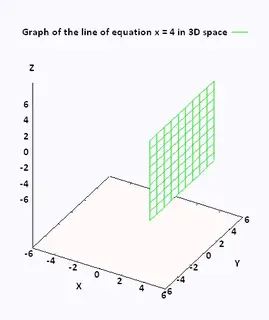 This is in represents . Any combination of xy has a z value of 3. This equation is parallel to the xz plane.
Distance formula in 3D
The distance, , between points and is:
Equation of a sphere
The distance between the center and any point on the sphere is the radius. Thus, Equation of a sphere with center and a radius is:
Finding radius and center
Find the center and radius of this example: Complete the square to get . The center is and the radius is .
Linked from 12.2 Vectors, Calculus III