Vectors are quantities that have a magnitude (size) and direction (length).
Written as v or v.
Two vectors are equivalent if they have the same magnitude and direction.
u=ABv=CDu=v despite being at different locations.
A zero vector, 0, has length of 0 and no direction.
Combining Vectors
To add the vectors u with v, position the initial point of v at the terminal point of u. The sum, u+v, would be the vector created from the initial point of u to the terminal point of v. This is called the "Triangle Law."
The order does not matter.
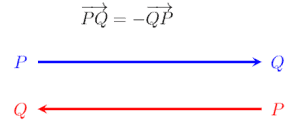
Negative scalars change the direction.
Multiplying a vector by c changes its length.
Real numbers work as a scaling factor which is why they are called "scalars". Non-zero vectors are parallel if they are scalar multiples.
b - a would be the same as b+(−a). Flip a and then apply the triangle law.
Components
Sometimes we place vectors at the origin.
Components are the individual x/y/z movements.
a=<a1,a2,a3> means move a1 units in the x direction, a2 units in the y direction, and a3 units in the z direction.
Vectors that start at the origin are called "position vectors".
To find the vector, a, between two points, A(x1,y1,z1) and B(x2,y2,z2):
a=<x2−x1,y2−y1,z2−z1>final−initial
Magnitude of Vector
The magnitude or length of vector v is denoted by ∣v∣ or ∣∣v∣∣.
The length of a 2D vector a=<a1,a2> is ∣a∣=a12+a22.
The length of a 3D vector a=<a1,a2,a3> is ∣a∣=a12+a22+a32. This is essentially the distance from the point to the origin.
Manipulating Vectors
Adding
To add vectors algebraically, add the components.
Given a=<a1,a2> and b=<b1,b2>,
a+b=<a1+b1,a2+b2>
Multiply by Scalar
To multiply vectors by a scalar, multiply each of the components.
Given a=<a1,a2> and scalar c,
ca=<ca1,ca2>
Properties of vectors
a+b=b+a
a+0=a
a+(b+c)=(a+b)+c
a+(−a)=0
c(a+b)=ca+cb
(cd)a=c(da)
(c+d)a=ca+da
1a=a
Special vectors
i^=<1,0,0>j^=<0,1,0>k^=<0,0,1>
The following forms are interchangable. Try to use the same format as in the prompt.
a=<a1,a2,a3>=a1i^+a2j^+a3k^
Unit Vector
A unit vector is a vector whose length is 1. i^, j^, k^ are all unit vectors. Turn a vector a into a unit vector by dividing the vector by its magnitude.
u=∣a∣1a=∣a∣a
Useful for unit spheres.
 despite being at different locations.