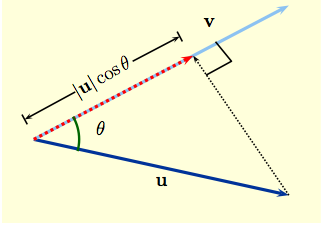
The dot product is a way to multiply vectors. Ends up with a real number called a scalar.
If a=<a1,a2,a3> and b=<b1,b2,b3>, then the dot product of a and b is the number a⋅b given by:
a⋅b=a1b1+a2b2+a3,b3
Dot proucts are also called "scalar product" or "inner product".
Properties of Dot Product
a⋅a=∣a∣2 because the magnitude is ∣a∣=a12+a22 and a⋅a=a12+a22
a⋅b=b⋅a
a⋅(b+c)=a⋅b+a⋅c
(ca)⋅b=c(a⋅b)=a⋅(cb)
Uses of Dot Product
a⋅b can be given a geometric interpretation in terms of the angle θ between a and b.
Theorem (proof uses law of cosine): If θ is the angle between a and b, then a⋅b=∣a∣∣b∣cosθ
Two vectors a and b are orthogonal (perpendicular) if and only if a⋅b=0. If a⋅b=0, we know that they are not perpendicular.
The sign of a⋅b is reliant on the cosθ because ∣a∣∣b∣ are always positive. Therefore, the dot product is:
positive if a and b point in the same general direction. 0<θ<2π
0 if perpendicular
negative if they point in generally opposite directions. 2π<θ<π
∣a∣∣b∣ if they point in the same direction.
-∣a∣∣b∣ if they point in opposite directions.
Projection
Vector Projection
Two vectors a and b have the same initial point P. projab represents the vector projection (distance and direction) of b onto a (The shadow of b).
Read as "prorjecting onto a, the vector of b".
Vector projection represented by
projab=(∣a∣a⋅b)∣a∣a=∣a∣2a⋅ba
because it's the unit vector (∣a∣a) in the direction of a multiplied by the scalar projection.
Scalar Projection
The scalar projection (magnitude) of b onto a ("component of b along a" or compab) is defined to be the signed magnitude of the vector projecetion.
The scalar projection can be calculated by
compab=∣a∣a⋅b
because compab=∣b∣cosθ. Replace cosθ with cosθ=∣a∣∣b∣a⋅b which comes from a⋅b=∣a∣∣b∣cosθ
Work and The Dot Product
In physics, work is defined as W=Fd. Only includes the force directed along the line of motion of the object.
Suppose D is the displacement vector.
Work done is defined to be the compdF multiplied by ∣D∣ (distance moved) or the dot product of F⋅DW=(∣F∣cosθ)∣D∣=F⋅D