Application Layer
Layer Responsibilities
Elaborating on the 4 layer internet model, who's responsible for what.
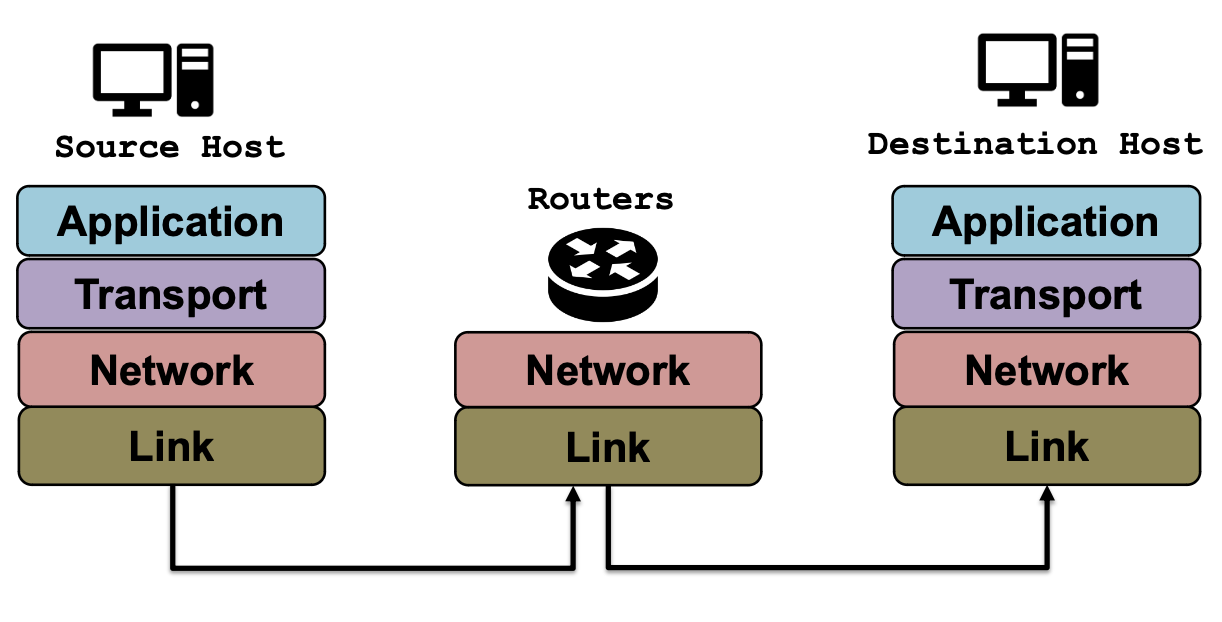
L4 Application
L3 Transport
- packets should not exhaust the network
- packets must retain their orders
L2 Network
- packets must be delivered between networks for global delivery
L1 Link
- bits arrive on wire
- packets must be delivered across links and local networks
Client-Server Paradigm
The client-server paradigm is a model of interactions between the client and the server.
Server is the computer or application that responds to requests from clients.
- always-on host
- permanent IP address
- often in data centers, for scaling
Clients are the user or application that initiates requests from a server.
- make contact, communicate with server, takes initiative
- may have dynamic IP addresses
- do not communicate directly with each other
Examples:
- in a web-based application, the user's browser is the client and it requests web pages from a web server
- email clients retrieve emails from mail servers
Peer-peer Architecture
Peer-to-peer arcitecture (P2P) is a decentralized network model where individual nodes ("peers") communicate and share resources directly with each other without a central server. Each peer can act as a client and a server.
Some characteristics include:
- server is not always on
- arbitrary end systems directly communicate
- peers request service from other peers, who provide service in return.
- they are self scalable, meaning that new peers bring new service capacity and new service demands.
Example:
- P2P file sharing.
Hypertext Transport Protocol:
HTTP is the protocol for exchanging information in the web. It's characteristics include:
- client-server architecture, meaning that the server is always on and well known and the clients initiate contact to the server
- synchronous request/reply protocol. It runs over TCP on Port 80.
- stateless
HTTP Messages
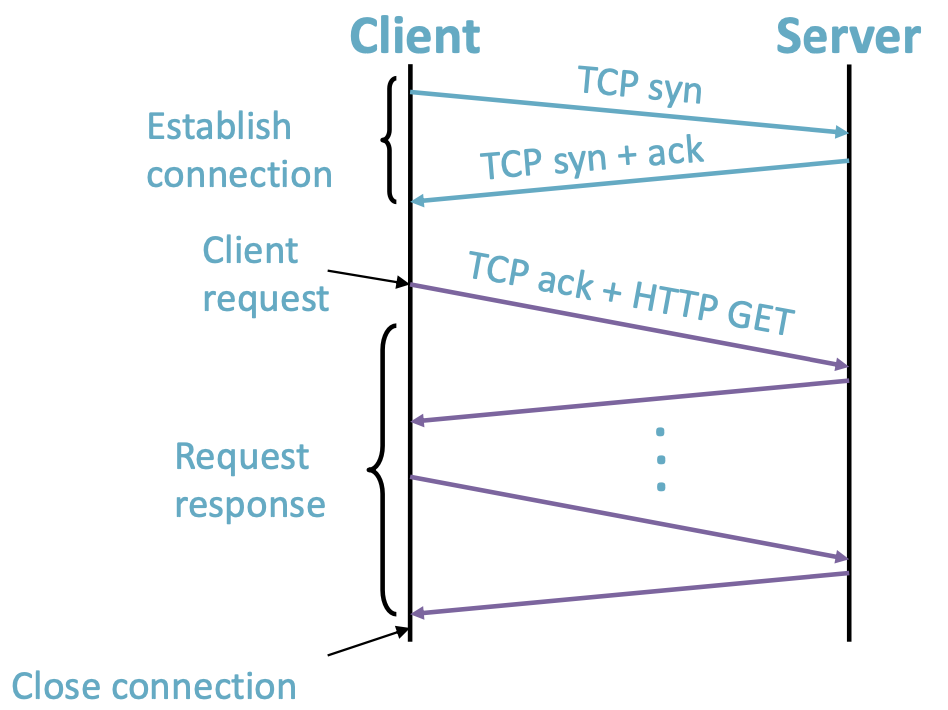
The steps in HTTP request/response in timeline:
- client establishes connection with the server
- Client sends TCP SYN message to the server
- Server sends TCP SYN + ACK message back to client
- Client sends a request through a TCP ACK (marks the end of three way handshake) + HTTP GET (starts the data transmission)
- Server responds to the request
- Connection is closed at the end
Request method types in HTTP 1.1 are
- GET, HEAD
- POST (send information)
- PUT (upload file to path)
- DELETE (delete file in URL field)
The HTTP Request message is composed of:
- request line: the method, resource, and protocol version.
- request headers: provide information or modify request
- carriage return line feed to indicate the end of the message
- body: optional data (e.g., to "POST" data to server) (comes after the carriage return line)
GET /somedir/page.html HTTP/1.1
User-agent: Mozilla/4.0
Connection: close
Accept-language: fr
(blank line)
data data data data...
The HTTP Response Message has:
- status line: protocol version, status code, status phrase
- response headers: provide information blank line
- body: optional data (like the requested HTML file)
HTTP/1.1 200 OK
Date: Thu, 06 Jan 2017 12:00:15 GMT
Server: Apache/1.3.0 (Unix)
Last-Modified: Mon, 22 Jun 2006
Content-Length: 6821
Content-Type: text/html
(blank line)
data data data data...
Cookies
HTTP being stateless means that each request-response is treated independently. The server does not need to maintain state.
- Pros: improves scalability on the server-side because it's easier to handle failure, it can handle higher rate of requests, order is irrelevant
- Cons: some applications need persistent state because you need to uniquely identify user or store temporary information (e.g., shopping cart, user profile, usage tracking)
To maintain client-side state in this stateless protocol, you can use cookies.
- Client stores small state on behalf of server and sends the state in the future request to the server.
- Can be used to provide authentication.
- The timeline is as follows: 1) the user makes a request 2) the server responds with a message with
Set-Cookie: XYZ3) in future requests, the header will includeCookie: XYZ. - Cookies can be abused because they provide a lot of personal information, like your preferences and viewing history, which is excellent for marketing opportunities but very concerning for privacy.
Performance Goals
Performance goals and their potential solutions:
- user should experience fast downloads and high availability
- can be done by improving networking protocols including HTTP, TCP, etc.
- can be done with caching and replication
- content providers make happy users and has cost-effective infrastructure
- exploit economies of scale like web hosting, CDNs, and data centers.
- network (secondary) should avoid overload.
- can be done with caching and replication
Naively, most web pages have multiple objects, so to retrieve, you could get one item at a time. This means a new TCP connection per object, which can be a lot!
So what exactly is the response time of an object request? Round-trip time (RTT) and describes the time it takes for a small packet to travel from client to server and back. It takes in total = 2RTT + Transmission time because of the following steps:
- 1 RTT for TCP setup (TCP SYN and TCP SYN+ACK)
- 1 RTT for HTTP request (TCP ACK + HTTP GET) and first few bytes
- Transmission time
Here are a few strategies related to HTTP performance, named the three "P"s
Using parallel or concurrent requests and responses.
- Pro: It would improve HTTP performance because there would be multiple connections in parallel
- Con: It would use a lot of network and you wouldn't maintain the order of responses.
- Good for client and content provider, bad for network
Persistent connections means to maintain a TCP connection across multiple requests.
- Pro: allow underlying layers (e.g., TCP) to learn about RTT and bandwidth characteristics
- Con: head-of-line (HOL) blocking and retransmitting lost TCP segments stalls object transmission
- Head of line blocking occurs when a packet at the front or head of a queue experiences delays, so all the packets behind it in the queue are also delayed.
Pipelined requests and responses: batch requests and responses to reduce the number of packets
- multiple requests can be contained in one TCP segment.
Linked from Computer Networks, Content Distribution Networks